Crowds
He preached in the open air to vast crowds, relying on the Dominican houses he found along his way.
Life
Dominican friar, master and itinerant preacher: for almost twenty years St Vincent Ferrer (1350–1419) travelled the roads of Europe calling people to conversion and reconciliation. This is his story, told from what the sources record.
1350 – 1398
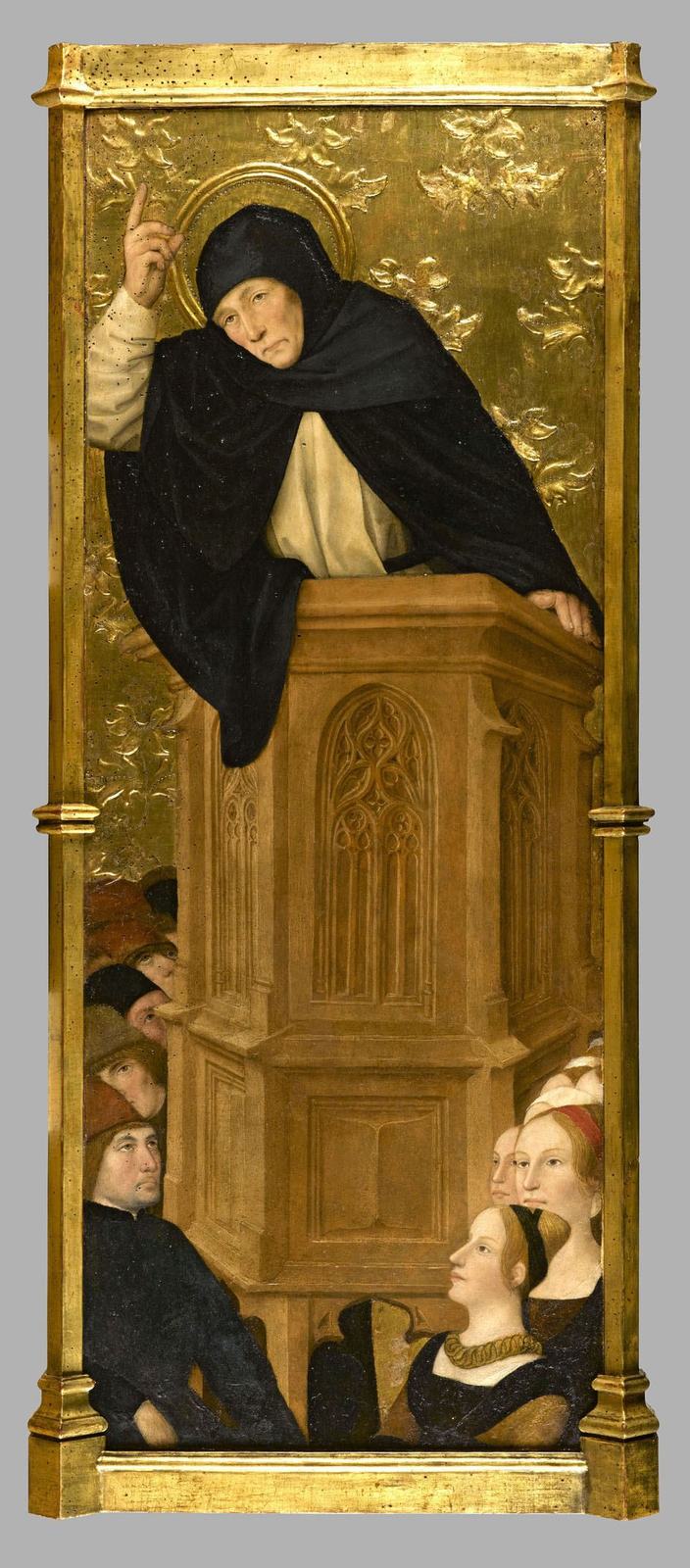
According to the most widespread tradition, Vincent Ferrer was born in Valencia on 23 January 1350. His parents were Guillem Ferrer, a notary, and Constança Miquel. He grew up in a comfortable Christian family, in a city still bearing the scars of the Black Death of 1348.
While still very young he entered the Order of Preachers — the Dominicans — at the friary in Valencia, making his profession around 1367. His formation took him to study philosophy and theology at several houses of the Order, among them Lleida, Barcelona and Toulouse.
Once ordained a priest, he taught and preached. His intellectual solidity, rooted in Thomism, and the austerity of his life soon won him a reputation both within the Order and beyond it.
1398 – 1419
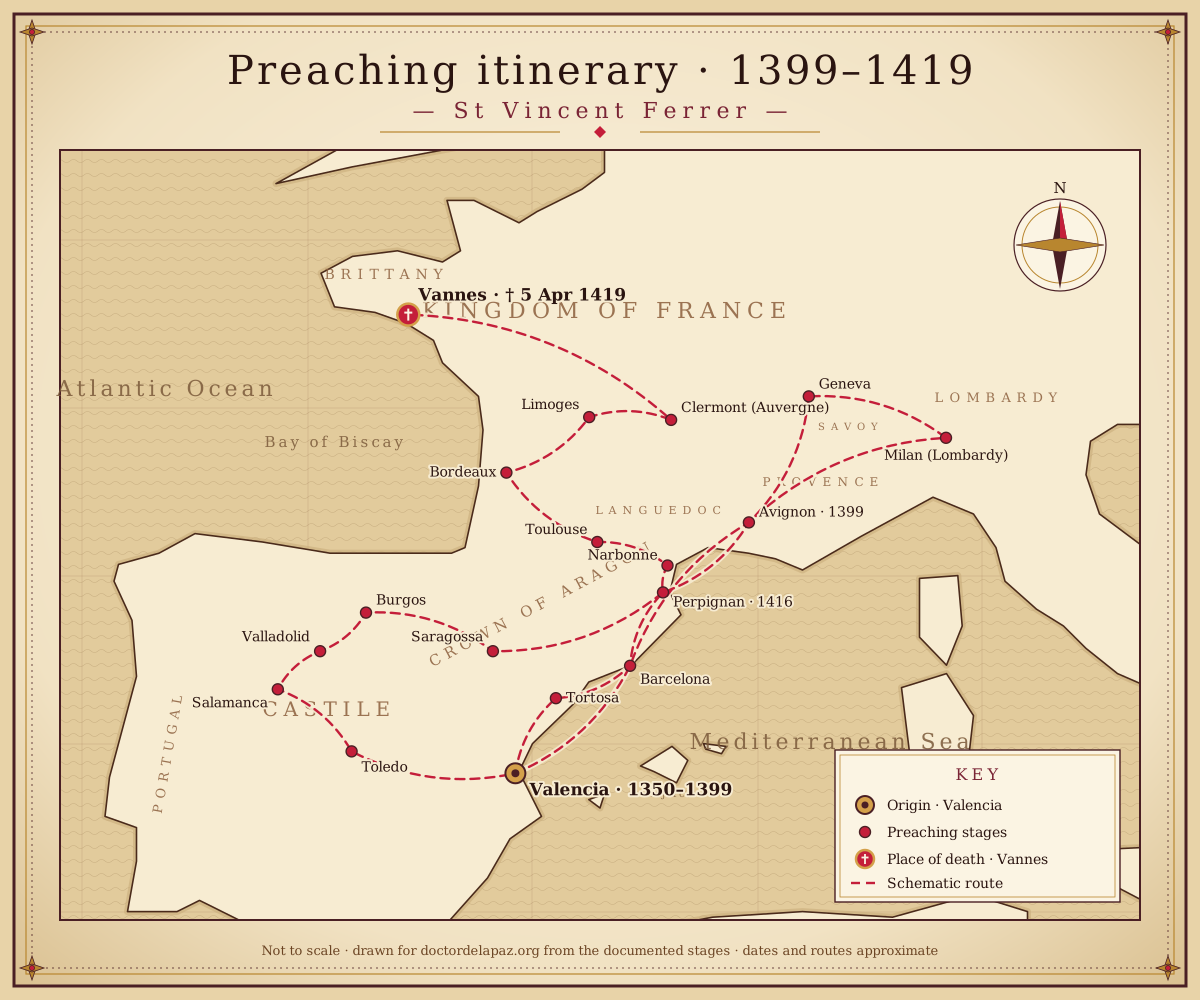
In 1398, while gravely ill in Avignon, he had — according to the accounts of his life — a vision in which he knew himself sent to preach. Shortly afterwards he began an itinerant mission that would last almost twenty years, across the Crown of Aragon, Castile, France, Italy and other lands of Europe.
He was called the “Angel of the Apocalypse” for the force with which he proclaimed the Last Judgement.
He preached in the open air to vast crowds, relying on the Dominican houses he found along his way.
His central themes: penance, conversion of heart and the nearness of the Last Judgement.
He mediated between rival factions and feuding families. In 1412 he served as one of the arbiters at the Compromise of Caspe.
1418 – 1419
In his last years he preached throughout Brittany. There, in the city of Vannes, he died on 5 April 1419, surrounded by a great throng of the faithful.
He was buried in Vannes Cathedral (Saint-Pierre), where his relics are venerated to this day. Vannes and Valencia are thus bound together by his memory: the city of his birth and the city where his journey ended.
1455
On 29 June 1455 he was canonised by Pope Callixtus III, himself a Valencian. The process gathered numerous testimonies and accounts of miracles collected in Brittany, Toulouse and Naples, among other places.
His feast is kept on 5 April, the anniversary of his death. He is patron of Valencia and a much-loved figure in both Valencia and Brittany.
Today a cause is being promoted for him to be declared a Doctor of the Church; that declaration has not yet been made and belongs solely to the Holy Father.